Mostrando entradas con la etiqueta Social Science. Mostrar todas las entradas

jueves, 1 de junio de 2023

Review of the Activity Book answers

 Dear students,

Here you can find the answers to the activities of the Activity Book.

Please, check the answers

Activity Book _ European Union_ Answer sheet!!

Review:

- Aims / Goals of the European Union

- History of the European Union (facts).

- Seven Main EU institutions and definitions: ___________

- Single Market in EU --> Characteristics.

    * Are there any advantages?

- Eurozone. What is it?

- Countries and capitals of the EU.  Where are they located?

* Austria, France, Italy, Germany, Sweden, Norway, Finland, The Netherlands, Portugal, Iceland, Greece, Ukraine, Hungary, Romania, Poland, United Kingdom 

https://mapasinteractivos.didactalia.net/en/community/mapasflashinteractivos/resource/countries-of-europe/d2bfae17-7658-4d3d-bce3-d4d5f316c52b

Definitions:

- barrier: something that it difficult to do something else.

- export: to send goods or services to another country.

- import: to buy goods or services from another country.

- inflation: rise in the prices of services and goods in a country which results in the value of money falling.

- Goods: Different types of products.

- currency: it´s the type of money used in a country or region.

- partnership: when two or more people or organisations work together to achieve a common goal.

- trade: buying and selling of products and services between people or countries.


miércoles, 31 de mayo de 2023

Social Science _ Review_ European Union

 Dear students,

Please, let´s try to check the following questions:

Note: Use your notes and the blog posts to answer the questions

  1. How many countries are there in Europe? How many are part of the EU?
  2. Please, mention two or three things (aims) that the EU promotes or encourages.
  3. Mention at least 5 important facts of the EU´s history and the dates.
  4. What are the 7 main EU institutions? Explain two of them.
    1. What is the difference between the European Parliament, the Council of Europe and the European Commission?
  5. What´s the EU single market? Why is it important?
  6. Name 10 EU countries and their capitals.

martes, 30 de mayo de 2023

The Single Market - Mind map

 Dear students,

Let´s continue reviewing the European Union and the single Market.

In the EU, there is a single market. This means that goods, people, services and money can move freely between all EU countries.


Mind map:
- What does the single market remove? 
- Do companies have to pay taxes to import and export? Is there any benefit?
- What do the goods and services sold in the EU have to comply with (follow)?
- What is the freedom of movement?
- Who has special access to the EU single market?


The Eurozone

The eurozone consists of the 19 countries which have adopted the euro as their currency. The euro was introduced in 2002.

What´s the eurozone?


viernes, 26 de mayo de 2023

European Union Institutions: there are seven main institutions.... Do you know them?? --> MINDMAP

Dear students,

Let´s take a look at the main European Union´s Institutions and create a mind map:

The EU has seven main institutions. They´re based in Brussels, Luxemburg, Strasbourg and Frankfurt.


Let´s create a MIND MAP of the EU´s Institutions:

- What are the 7 main European Union´s institutions?

- What´s European parliament responsible for?

- What does the Council of European Union discuss?

- What does the European Council do?

- What does the European Commission do? Who works in the European Commission?

- What is the "Court of Justice of the European Union"? 

- What does "European Court of Auditors" and "European Central bank" do?


How does the EU work? video!!

EU´s institutions! video


lunes, 22 de mayo de 2023

European Union´s history

 Dear students,

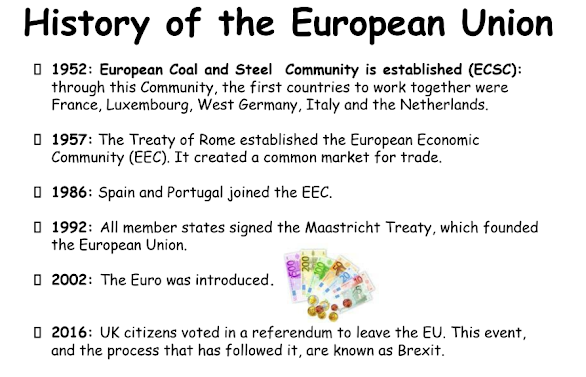
We are starting to look a little bit closer into the European Union. Please, check the following important dates and milstones:


Please, review the following dates and try to name what important fact was done on each date.


What are some of the most important dates and facts in the European Union´s history?
1.) _____________________________
2.) _____________________________
3.) _____________________________
4.) _____________________________
5.) _____________________________
6.) _____________________________


martes, 9 de mayo de 2023

Review worksheet for Social Science Europe

 Dear students,

Please, review the following worksheet for the Social Science Europe test:

(click on it)

Social Science Europe Revision Worksheet!!

Please, check:

  • Europe Time zones with examples.
  • Mountain ranges in Europe
  • Rivers in Europe
  • Europe coastal areas (Bays, gulfs, capes, Fjords, lakes, rias).
  • Definitions
  • Activity book and revision worksheet

miércoles, 3 de mayo de 2023

Social Science Activities _ Wednesday 3rd May 2023

 Dear students:

Please, check the following activities:

1.) What are the names of the four time zones in Europe? Could mention some countries that are included in each time zone? When it is 12:00 o´clock in London, what time is it in Paris, Berlin and Moscow?

2.) Copy and complete the text about Europe:

Europe is the __________ smallest continent in the world after Oceania. To the north it reaches ___________. To the west it reaches the _____________. Ocean and to the east it reaches the ____________. Europe has ____________ countries. The biggest country is ___________. The biggest country entirely located in Europe is _____________.

3.) Order these mountain ranges from the east to the west. Check the maps in your activity book or in your notes.

- The Alps // The Pyrenees // The Urals // The Caucasus // The Carpathian Mountains

4) What is a Fjord? Check the Video

Check the video to answer the question above !!

5) How do glaciers shape the landscape?

Check -> How do glaciers shape the landscape video!!

6.) Where are the following mountain ranges located? In which countries?

a) Pyrenees.

b) Caucasus.

C) Apennines

D) Ural Mountains

E) North European PLain

F) Alps

G) Balkan Mountains

H) Mont Blanc

J) Mount Elbrus


jueves, 27 de abril de 2023

Social Science Review:

 Dear students:

Please, check the following activities:

1.) What are the names of the four time zones in Europe? Could mention some countries that are included in each time zone? When it is 12:00 o´clock in London, what time is it in Paris, Berlin and Moscow?

2.) Copy and complete the text about Europe:

Europe is the __________ smallest continent in the world after Oceania. To the north it reaches ___________. To the west it reaches the _____________. Ocean and to the east it reaches the ____________. Europe has ____________ countries. The biggest country is ___________. The biggest country entirely located in Europe is _____________.

3.) Order these mountain ranges from the east to the west. Check the maps in your activity book or in your notes.

- The Alps // The Pyrenees // The Urals // The Caucasus // The Carpathian Mountains

4) What is a Fjord? Check the Video

Check the video to answer the question above !!

5) How do glaciers shape the landscape?

Check -> How do glaciers shape the landscape video!!


viernes, 14 de abril de 2023

Europe´s rivers - mindmap and video

 Dear students,

Let´s continue with Europe´s rivers.


- Could you create a mindmap with the following questions?

- What European rivers flow into the Artic Ocean?

- Where do the Thames, Elbe and Rhine flow?

- Where is the Baltic sea located? What rivers flow to the Blatic sea?

- What are some European rivers that flow to the Atlantic sea?

- What´s the second longest European river? Where does it flow?

- What rivers flow to the Black sea and to the Sea of Azov?

- Are there any European rivers that flow to the Meditarranean sea from Spain, France and Italy? Which are those?

- Which is the longest river in Europe and where does it flow?

Watersheds and rivers in Europe video!! 

Major seas and rivers of Europe continent video!

martes, 28 de marzo de 2023

Europe´s relief:Social science Mind Map

 Dear students,

Let´s create a mindmap of Europe´s relief with the class notes:

First Part of Europe´s relief map with the important mountain ranges!

- What´s Europe hightest mountain range and its highest mountain and height?

- What´s Europe´s longest mountain range and distance? What does it form?

- Where is the Caucasus and what does it include?

- Where are the Apennines?

- What do the Pyrenees form?

If you have time, you can try to draw them in your notebook.

Click to watch "Europe´s relief" video !!

jueves, 9 de marzo de 2023

Social Science review:

 Please, review the following items:

- What´s a democracy?

- What does the constitution guarantee?

-  When do we have elections? Every 2, 4 or 6 years? What are some characteristics of elections?

- What is the difference between right and responsibility?

- The separation of powers

- Types of public services

- Budget and taxes

lunes, 6 de marzo de 2023

Public services, taxes and budget - Let´s review and create a Mindmap

Dear students,

Let´s investigate a little bit more about the public services in Spain

What are the public services? Who provide them? How do we pay for them?

Public services are those which are provided by the government. The citizens pay taxes in order to pay these public services, so then, they don’t need to pay extra money for it: health care, education, security guards, waste patrols, gardening services...

The constitution guarantees everyone’s right to public services. It also establishes everyone’s duty to pay tax to finance public services.

I.) LOCAL COUNCILS are generally responsible for services such as street lighting, waste collection and treatment, libraries, parks and sports facilities.

II.) The national government provides public services such as social security, tax collection, the military, civil guard and national police.

III.) Autonomous communities have different levels of responsibility for public services: education, health and public transport. Some of autonomous communities, even have their own police force: “Ertzaintza” in País Vasco or the “Mossos d’Esquadra” in Cataluña

Taxes:

Public services are paid for with taxes. Taxes are deducted from workers´salaries and the profits that companies make. We also pay tax when we buy products or use a service. This is called value-added tax (VAT).

A budget is a plan for how to spend money. The national´s goverment´s budget is about 470.000 million per year. A lot of this money is used to pay the pensions of retired people and to support people who are unemployed. 


Let's create a mindmap with some previous questions!

- What are public services?- What do citizens do to contribute or pay for the public services?
- what does the constitution guarantee?
- what are the local council government responsible for?
- what public services does the national government provide?
- what level of services do the Autonomous Communities have?
- Why do we need taxes?
- what is a budget?
- can you mention an example of how the national budget is used?

jueves, 2 de marzo de 2023

Separation of Powers

 Dear students,

Let´s try to complete the following activity with your notes:


How does the legislative power work?

Complete the sentences:

a) The different powers established by the Constitution of 1978 are ______________
b) Democracy means ____________________________________________
c) Spain is a parliamentary monarchy, which means ___________________
d) Spain has four co-official languages, which are _______________________
e) The UN Universal Declaration of Human Rights establishes _______________
f) The Statute of Autonomy defines ___________________________________

Spain is a democracy. What is a democracy? It´s a form of goverment, which the people can vote and choose what kind of political party or representative, they want to run its country, city or town.

The process of choosing a political party representation is called elections.

In the constitution (1978) we have rights and responsibilities. The rights are the things that we should have or should be able to access. The responsabilities are the things we must do. 


miércoles, 1 de marzo de 2023

Separation of Powers in Spain´s Political System

Dear students,

Is separation of powers important for a country or not? Why do you think so?

What kind of powers do we have in our democracy or political system?

SEPARATION OF POWERS

The constitution establishes that a government has to be divided into three different parts or branches: the executive, legislative and judicial. This is to make sure that the power is not concentrated in just one person or an organism can decide about a law. This way, laws are decided by more professionals and can be more objective and equally.

I. THE LEGISLATIVE BRANCH

 Is the part of the government that makes the laws. It is done in the PARLIAMENT (parlamento).

It has two processes:

1.- First, a new law proposal is introduced in the Congress (Congreso de los Diputados). Here, it is debated (pros and cons). All laws proposed have to follow the constitution. When Congress agrees with the law, then, it goes to the SENATE to think about it. 

2.- The SENATE (El senado) approves or rejects  laws passed by Congress. The Senate is made up of 260 senators who represent Spain’s autonomous communities, provinces and cities.


II. THE JUDICIAL BRANCH

The justice is exercised by the judiciary. This is made up of judges and magistrates who work in courts and tribunals. In this case, they decide when a law has been broken and it is imposed a punishment.

III. THE EXECUTIVE BRANCH

It’s the part of the government that puts in practice the laws and gives services to the citizens. The government implements the law for civil, military and domestic administration.

 The government consists of the PRIME MINISTER (head of government) and the MINISTERS (responsible for specific areas: economy, education, health).

SUMMARY:

Spain is a democracy. The government is elected by the people. Spain’s democracy is based on the 1978 Constitution. People in Spain can vote when they are 18. In a democracy, everybody has rights, such as the freedom to express opinions and to be treated equally. 

Living in a democracy also brings important responsibilities. Everybody must obey the laws and pay taxes to support public services such as health and education.


SUMMARY:

Spain is a democracy. The government is elected by the people. Spain’s democracy is based on the 1978 Constitution. People in Spain can vote when they are 18. In a democracy, everybody has rights, such as the freedom to express opinions and to be treated equally.


Living in a democracy also brings important responsibilities. Everybody must obey the laws and pay taxes to support public services such as health and education.


miércoles, 15 de febrero de 2023

SPAIN POLITICAL SYSTEM! Let´s review

 Dear students,

Let´s try to review what we can remember of Spain´s political system!

Do we have a democracy or a dictatorship? Are there free elections? Do we have a democracy?

Is there a constitution? What does it include? Do we have division of powers?

Let´s try to read and understand the following info:

Spain is a democracy. A democracy is a form of government, which the people can vote and choose what kind of government want to run its country, city or town. A democracy is different from a dictatorship, in which one person (the dictator) makes all the rules. Many countries have a democratic form of government: Italy, France, United Kingdom, Norway, Canada, The United States, Japan...

The first democracies began in Greece, 2,000 years ago. The weyre very basic. It wasn’t until the French Revolution when people started to think that all people should have some rights, like to participate in the government. In every democracy, there are elections: some different political parties present their proposals and people choose freely what they prefer to. 

Many democracies are based on a constitution: a document containing the basic laws, rights or principles for a country. Spain’s Constitution was in 1978. The Spanish constitution guarantees fundamental rights. Rights are something we should have or be able to do. It also includes our responsibilities as citizens, which are the things we must do.

After reviewing the previous info, try to answer the following questions:

- What´s the difference between a democracy and a dictatorship?

- What happened to the democracies after the french revolution?

- What are the democracies based on?

- What does a constitution include?

CLick to watch "Separation of Powers in Spain" video

jueves, 9 de febrero de 2023

Spain geography mindmap!! Questions!

 Dear students,

Please, complete the following mindmap, review the notes in your notebook, the activity book and answer the questions.

Let´s review:

  • Autonomous communities and general info (notes)
  • Provinces (general info) in the autonomous communities (Galicia, Castilla León, Castilla La Mancha, Extremadura, País Vasco, Cataluña, etc...)
  • Rivers of the Cantabrian sea watershed, Atlantic ocean watershed and Mediterranean watershed.
  • Spain´s Relief in the north, east, south and west.
  • Coastal line: capes, gulf, bays, cliffs and sand beaches.
  • Definition of Gulf, Bay and Cape


  • Can you mention a mountain range in the south and another in the north west?
  • Can you write a river that flows to the Cantabrian sea and another that flows into the Mediterranean sea?
  • Are you able to locate a mountain range on the edge of the Meseta Central?
  • Could you mention a Cantabrian cape and a Mediterranean gulf?

miércoles, 8 de febrero de 2023

martes, 31 de enero de 2023

Spain´s geography!!

  GEOGRAPHIC: SPAIN.

Let's make this challenge for you to know how much you can do without any help. 

Try to find the Autonomous Communities and the provinces with the next maps. First, read in your Social Science unit and try to remember without looking. Then, do the activity and find as much as you can. Only when you need help, you can have a look in your notebook, or through the Internet.

LET'S GO FO IT! 

SPAIN: MAPS (digital practice)


Let´s try to check how much you can remember regarding rivers and relief of Spain:

Rivers in each watershed:

  • Cantabrian watershed: __________________________
  • Atalntic watershed: ____________________________
  • Mediterranean watershed: _______________________ 


What are the different mountains and mountain ranges in Spain?

Let´s try to review them:
  • Macizo Galaico.
  • Montes de León.
  • Cordillera Cantábrica.
  • Picos de Europa.
  • Montes Vascos.
  • Pirineos.
  • Sistema Ibérico.
  • Sistema central.
  • Sierra Morena.
  • Sistema Bético.
  • Cordillera Bética.
  • Cordillera Penibética.
  • Meseta central.
  • Submeseta norte.
  • Submeseta sur.
  • Mulhacén. 
  • Teide.


domingo, 22 de enero de 2023

Spain geography: interactive mindmaps

 GEOGRAPHIC: SPAIN.

Let's make this challenge for you to know how much you can di without any help. 

Try to find the Autonomous Communities and the provinces with the next maps. First, read in your Social Science unit and try to remember without looking. Then, do the activity and find as much as you can. Only when you need help, you can have a look in your notebook, or through the Internet.

LET'S GO FO IT! 

SPAIN: MAPS (digital practice)


jueves, 19 de enero de 2023

Create a mindmap related to Spain´s rivers!!

 Dear students,

Let´s try to review some of the items related to the Spain´s reviers and coastal relief:

  • How can the rivers can be classified in Spain?
  • What is a watershed?
  • What do the rivers that flow into the Cantabrian Sea form?
  • What are the three watersheds? 
  • What are the important rivers of each watershed in Spain?
Please, complete the following table in your notebook:


Let´s play the following game:


Revision of Unit 3 _ Vocabulary of the unit_ Grammar _ Verb focus _ Assignments / Writing

  Dear students, Please review the following items for the Unit 3 test: Vocabulary with definitions related to chores (taks performed in the...